PRODUCT INFORMATION / REVIEWS:
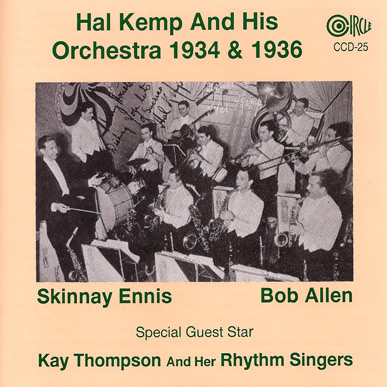
Kemp was born in Marion, Alabama, in 1905, organized his first band when he was in high school in Charlotte, N. C., in 1921. John Scott Trotter was a freshman in the same high school when Kemp was a senior but he was not in Kemp's band, the Merry Makers. When Kemp went to Chapel Hill and played with the Carolina Club Orchestra, his older brother, a booker and band agent, got the band an audition in New York with Paul Specht, a well-known band leader who was also a booker. Specht took the band to London for a summer and Kemp stayed on, playing saxophone in the band for a year before returning to college. As a belated junior at North Carolina in 1925, Kemp organized a band with John Scott Trotter on piano, Skinnay Ennis on drums and Saxie Dowell on saxophone, all of whom were key figures in the band's success. With the help of Fred Waring, whose band also started in college at the University of Pennsylvania, Kemp's band was booked into the Strand Roof in New York and went into other places where Waring's Pennsylvanians regularly played. In 1927, Kemp's band became the house band in The Grill of the Hotel Manger in New York, which is now the Taft Hotel. It stayed there for three years and then, in 1930, went to London and Paris where it had a great success. In London, it was a favorite of British society at the Cafe de Paris and in Paris it played at Les Ambassadeurs. During the summer of 1930, Bunny Berigan, who had just come out of the University of Wisconsin, joined the band on second trumpet. ... When the band returned to the States in 1931, it went into the Blackhawk Restaurant in Chicago where its radio broadcasts, sometimes as many as three a night, made its very distinctive style known to listeners all across the country. In 1934 it moved its base to the Madhattan Room of the Hotel Pennsylvania in New York which, two years later, would become the home of Benny Goodman's newly famous band. In the late 30s, when Kemp had his greatest commercial success, he diluted that success with a bit of poor judgment. By then, Benny Goodman was the King of Swing and swing was the big thing. Kemp decided that his band should be a swing band, too. So his arrangements, moving in that direction, lost some of his recognizable identity without rising to the swing level of Goodman or Artie Shaw. Guy Lombardo, his fellow sweet band stylist, never made that mistake: He stuck to his style and survived. But it was not just a dilution of style that brought the Kemp band to a stop. It was the mortality of flesh. In 1940, at the age of 35, Kemp was driving a Lincoln convertible that he had bought four days earlier on his way to an engagement in San Francisco. He hit a slick place on the highway near Madera, Calif. His car skidded and hit another car head-on. Kemp died in the hospital in Madera on Dec. 21, 1940. This album was recorded on Dec. 14, 1934, when the Kemp band was in its first season at the Madhattan Room of the Hotel Pennsylvania. It is a typical mixture of the variety of material that the Kemp band played then - show tunes ("You're the Top," which was then brand new), jazz ("Mood Indigo"), Latin pieces ("Panama," which is not the old New Orleans jazz favorite), vocal novelties ("Down T'Uncle Bill's," a totally forgotten song by Johnny Mercer and Hoagy Carmichael), instrumental novelties ("Christmas Night in Harlem," which was a vocal hit for the singing team of Johnny Mercer and Jack Teagarden with Paul Whiteman's Orchestra), college songs ("Washington and Lee Swing"), pop songs ranging from the long lasting "Blue Moon" (new at the time) to the ephemeral "Midnight, the Stars and You," and one of the basics of the Kemp repertory, Saxie Dowell's "I Don't Care,"which the band first recorded in 1928 and for which, when it was later sung by a vocal trio, the band held "southern accent rehearsals." It also shows off both Skinnay Ennis' breathless singing and the stronger, more traditional singing of Bob Allen who was so influenced by Skinnay that, when Skinnay left Kemp to lead the band on Bob Hope's radio program leaving Allen as the sole male singer with Kemp, Allen began to sound even more like Skinnay than Skinnay had. John S. Wilson (Editorial Staff of High Fidelity Magazine and is Entertainment Reviewer for the New York Times.)
PERSONNEL
TRACKS
|
||