PRODUCT INFORMATION / REVIEWS:
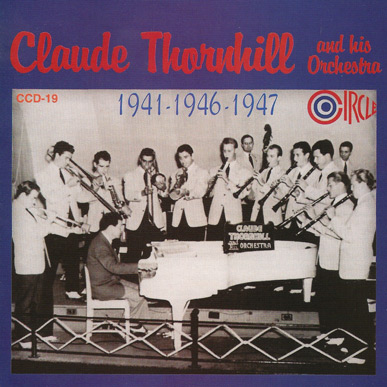
It is one of the tragedies of the music world that neither Claude Thornhill's lifetime achievements nor his posthumous reputation have sustained the recognition he deserved, Somehow he never quite attained the merit he deserved, for he was a musician, leader and arranger of outstanding ability, He had a special interest in harmony which gave to his group its subtleties and tonal qualities that some reviewers felt blossomed more in live performances than in recordings. Indeed, in the early forties, prior to joining the Navy, his band was one of the most popular for both dancing and listening. But that initial eclat was never reached again after he left the forces, although he continued playing until his death in 1965. ... Claude Thornhill was born in Terre Haute, Indiana, on August 10th, 1909, to a coal-mining father and a mother who was both a church organist and a choir director. Her influence was important in his musical development. He started to learn the piano at the age of four and by six had organized, with his friends, a group called "The Harmonious Outcasts." His musical career took a slight detour when, at the age of 15, he ran away from home and played a steam calliope on a Mississippi riverboat. Returning to a more accepted route, he studied at the Cincinnati Conservatory of Music and the Curtis Institute of Music, This classical training is discernible in such titles as "Hungarian Dance No. 5" and "Grieg's Piano Concerto." His arranger, Gil Evans, wrote "Arab Dance" from Tchaikovsky's "The Nutcracker Suite" for Thornhill, also "The Troubadour" from "The Old Castle," one of Mussorgsky's "Pictures at an Exhibition." In 1926 he joined the Austin Wiley Orchestra which played at the Golden Pheasant Club in Cleveland. Artie Shaw was the influence obtaining that engagement for him and the two friends left together for New York in 1931 where they played for Benny Goodman. By 1935, Claude was a part of the renowned Ray Noble Orchestra, along with such future big names as Glenn Miller, Charlie Spivak, Will Bradley and Pee Wee Erwin. Thornhill was recognized not only for the great pianist that he unquestionably was, but also as an accomplished arranger. During the '30s he supplied Freddy Martin and Andre Kostelanetz, Paul Whiteman, Bing Crosby, Hal Kemp and John Kirby with arrangements. He formed lasting friendships with many of these fine musicians. His quiet nature and wit were much appreciated. Three female singers had reason to be grateful for his efforts on their behalf. Under his influence, a singer named 'Maxine Williams changed her name to Maxine Sullivan, altered her style of music. and struck it big with his arrangement of "Loch Lomond." Another big hit came for Fran Warren, with whom he recorded the famous "Sunday Kind Of Love." Judy Garland was another notable beneficiary. While in Hollywood, he worked on arrangements for some of her films, the best known being "Babes In Arms." He also worked a great deal with Bob Hope. By 1940 big band music was all the rage. The volume of records and of radio and variety shows attested to its popularity. At that time Claude Thornhill gathered his own orchestra. Notable players included the clarinetist Irving Fazola, and trumpeter Conrad Gozzo. In 1942 Thornhill and his orchestra were playing to enthusiastic crowds at the Glen Island Casino in Long Island Sound. Unfazed by gasoline rationing the young people came to listen and dance. And what richness they enjoyed! Claude Thornhill was a pianist of delicate touch and superb subtlety. Above all he fostered a mixture of musical innovation which combined with his good ta.ste to produce music that was close to a· modern classical strain. He gave his audiences a good beat and a good melody, while experimenting with the dynamics of his group to produce the recognizably rich "Thornhill sound." One trademark was the playing of his clarinet section in unison. But world events intervened to dull the shine of his success, and the draft called many of his key men away. He was appearing at the Paramount in new York City immediately before his enlistment in the Navy in 1942. He served as Chief Musician with a Navy band in the Far East until his discharge in 1945. In the Spring of '46 he reorganized his band, gathering round him Rusty Dedrick, Bob Jenny, Johnny Nelson, Tasso Harris, Gil Evans and Bill Borden. At other times Danny Polo, Irving Fazola, Lee Konitz and Gerry Mulligan worked with him. He was now to make a contribution that led directly to the "cool" jazz of the end of the decade. His orchestra's sound was varied by such innovations as employing the French horn, augmenting the brass section, using a three-man flute section or including a tuba. His performances were never showy; that would have been contrary to the character of the man. He appeared vague, relaxed, so that his quick wit was unexpectedly startling. But the vagueness did not disguise his musicianship. Unfortunately, during the intervening war the public's tastes had changed. Vocalists such as Frank Sinatra, Dinah Shore, Dick Haymes and Perry Com·o were the great attractions; swing was on the decline. Claude Thornhill reached the height of his popularity in '46 and '47 when his orchestra was voted number one in the Sweet-Band polls of "Billboard" magazine. His theme song and most popular composition was "Snowfall." In 1946 "A Sunday Kind Of Love" was the closest he ever came to a big hit. A year later he came close again with "Robbin's Nest" which was named for a New York disc jockey, Fred Robbins. But by 1948 the decline set in. Despite critical acclaim his popularity was waning. His appearances, with a smaller group, consisted mainly of concerts and dancing engagements on college campuses. He had played at such famous spots as the Post Lodge in Larchmont, the Meadowbrook, the Strand Theatre in New York City, the Eastwood Gardens in Detroit and the Palladium in Los Angeles. He was scheduled to perform at the Steel Pier in Atlantic City when a second heart attack ended his life in 1965 at the age of 56. Why was he not better known and more popular? That is one of the mysteries we'll never know. At the end he faced growing uninterest in his slowing tempos and his subtlety. In 1947 he made a double appearance with Lawrence Welk. At that time he topped the bill, but Welk proved to be the survivor. Except among a small group of afficionados, Claude Thornhill's music has been eclipsed. Perhaps now the time has come for his brilliance to shine again. - Roberta Stein There was a freshness about the approach that Claude Thornhill brought to the Big Band Era. This originality was obvious from the early days, the Maxine Sullivan days, and both his pre- and post-war bands. It is a pleasure for Circle to offer these very fine recordings made by the Claude Thornhill bands. If you have enjoyed this album, we would also like to recommend other Circle releases by Richard Himber, Russ Morgan, Jimmie Lunceford, Dean Hudson, John Kirby, Tommy Tucker and Charlie Spivak. George H. Buck, Jr
PERSONNEL
TRACKS
|
||