PRODUCT INFORMATION / REVIEWS:
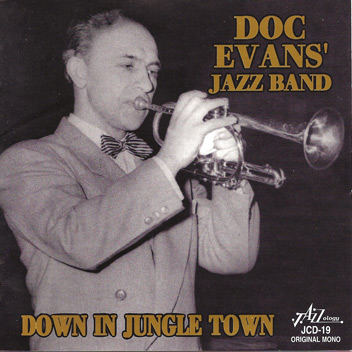
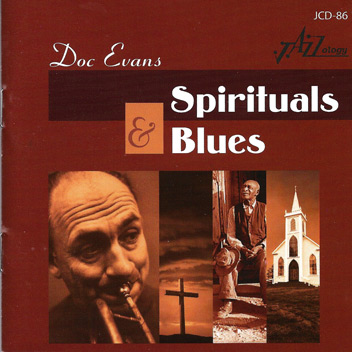
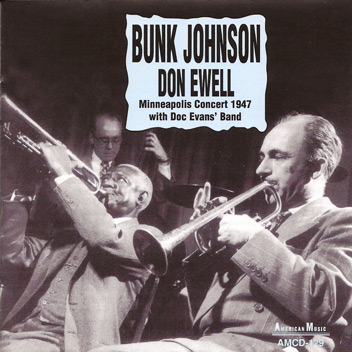
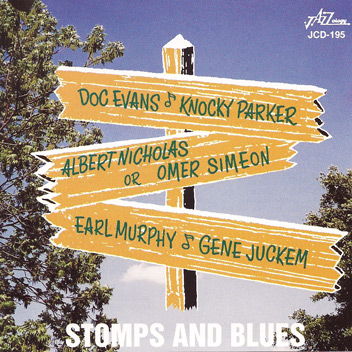
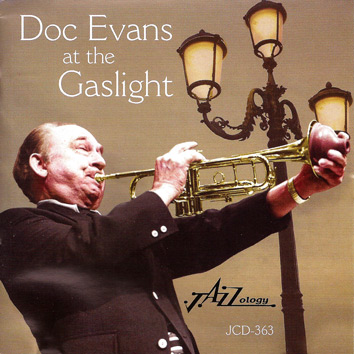
The very fine cornetist Paul "Doc" Evans was one of the pioneer recording artist on Ewing D. Nunn's Audiophile label, and we are pleased to restore to the catalogue Evans' first Audiophile session dating from May, 1953. The recordings were first released on 78rpm microgroove pressings as AP-11 and AP.12. The material was subsequently reissued on conventional LP by Nunn as Audiophile XL-328. -George H. Buck This album takes us smack dab back to the early '50s, when the traditional jazz revival was still going strong. The jazz world had split into two armed camps, with the modernists and the traditionalists hurling brickbats at each other. Doc Evans left little doubt as to which camp he belonged to. Bebop, Evans once told the Milwaukee Journal, was a "wild sort of disjointed-sounding thing that is decadent and has no musical right to exist." - Chip Deffaa; Jazz Critic, THE NEW YORK POST; Radio Host, WWFM (Trenton NJ) ... He told another interviewer in 1953 (the year these recordings were made): "I'm not out to win the Downbeat Poll. I'm just trying to get the real jazz across." The real jazz. You don't talk like that much anymore. But for Evans and his followers, vintage numbers like "Riverside Blues" and "Blues My Naughty Sweetie Gave to Me" - played in a firmly-set style - were the only real jazz. Evans' music was - like that of Red Nichols -- a predominantly light, happy kind of music. He couldn't project the soulful, mournful tone some of the older black players could; he hadn't known their oppression. The zesty, optimistic sound he so often projected reflected his comfortable, middle-American background. Born June 20, 1907 in Spring Valley, Minnesota, Evans got his B.A. at Carleton College (Northfield, Minnesota), and then did a year of graduate work at the University of Minnesota in Minneapolis. And - like many other white aspiring jazzmen of the midwest - he initially discovered jazz via records by white musicians. His cornet always retained an indentifiably "white" sound, although as he got older and listened more to early black jazzmen, he did assimilate some darker, more ascerbic strains. "Our first idol was Nichols, with his Five Pennies,, Evans recalled in the mid '40s. "Our second was Beiderbecke, with his Gang or with Trumbauer, and later with Goldkette, or even with Whiteman. It was the Austin High Bunch, McKenzie and Condon's Chicagoans or the Chicago Rhythm Kings that seemea to us most important as a group. "Red's stuff we frequently took note for note. Bix wasn't so easy to copy, but the Chicagoans we imitated mostly in spirit. From those sources evolved the essence of the solo and ensemble style employed by most of us here today ....." "In our formative years we didn't know anything about Oliver or Morton, and not much about Henderson or Ellington… all of us paid attention to Armstrong and Hines, but none of us played like them and few even tried." In the early '50s, Evans acknowledged that he had only recently become aware of such gifted, but less-renowned black jazz artists as Jabbo Smith and Punch Miller. Evans rarely traveled too far from his native Minnesota. His first professional job was with Dave Wing in Minneapolis in 1928. In the 1930s, he taught high school English for a year, and then ran his own kennel. But playing jazz was always his first love. Evans developed a following as a musician while playing (1939-42) at "Mitch's" (a Minnesota roadhouse called the Midwest equivalent of "Nick's" in New York); years later, he recalled that that was the only gig he ever had where he couldn't wait to go to work each night. The audiences were enthusiastic. And big band leaders always found their way to Mitch's. Evans turned down offers to join touring big bands, including Ray McKinley's and Claude Thornhill's; he believed Bix's life had been a warning against going that route. Studs Terkel, who caught Evans during a spring, 1947 Chicago club engagement, wrote: "The quiet, soft-talking little guy lays his head against the wall and blows the cornet, tender, loving, powerful." Evans may not have possessed the fire, imagination, or technical prowess to rank him among the first-rate players. His tone is not as brilliant as Red Nichols. But he had the drive and spirit to keep the music buoyant and listenable. He was a strong presence on his recordings, ever urging the ensemble on, but he never tried to hog the show. As he explained in 1948: "It's not playing every note you can, but leaving holes for the other guy to fill. And not playing as loud or as fast as you can, just for technical display." On this album, "Under the Double Eagle" is offered with an almost circus-band kind of cheeriness, with a Red Nichols-ish intro and ending. The overall treatment reminds me a little of the way Nichols' Five Pennies of the '50s handled, say, "Entry of the Gladiators." "Riverside Blues" was first recorded by King Oliver back in 1923, and has long been a staple of Traditional Jazz Bands. Evans' playing here shows hed incorporated some of Armstrong's grand feel for phrasing. "Down in Jungle Town", first recorded by Red Allen in 1940, opens with simulated animal sounds, a gimmick which recalls the earliest days of recorded jazz. "Mama's Gone, Goodbye" was recorded in 1923-24 by such diverse artists as Piron's New Orleans Orchestra, Clara Smith, and Guy Lombardo. Bob Crosby's Bobcats - who Evans cited as one of his all-time favorite groups - recorded it in 1940. Fields and McHugh's "Diga Diga Doo", a hit from the show Blackbirds of 1928, was recorded back then by countless big names (from Duke Ellington on down). "Blues My Naughty Sweetie Gave to Me' was recorded, back in 1919, by the Louisiana Five (with Alcide Nunez, clarinet) and the Whiteway Jazz Band (with Ross Gorman and Ted Fiorito). The tradition of swinging "Maryland, My Maryland" goes back to early New Orleans brass bands. Bob Crosby's Bobcats wanted to record that number in 1938, but Decca president Jack Kapp argued that some people would find it irreverent; they changed the melody line slightly to produce their famed "March of the Bobcats." The "Yellow Dog Blues" ("the Yellow Dog" being the nickname of the Yazoo Delta Railroad) was recorded by W.C. Handy's Memphis Blues Band (1919), Bessie Smith (1925), and others. When Smith sang that her man had gone "where the Southern cross the Yellow Dog" the reference was to the prison near the crossing of the Southern Railroad and Yazoo Delta Railroad lines. In the 1960s, Doc Evans ran his own jazz club ("Rampart Street" in Mendotta, Minnesota), and directed the local synphony. He also found time in his career to lecture on jazz at the University of Minnesota and to write jazz criticism for The Jazz Record. He died January 10, 1977. These eight representative recordings should bring back good memories for old fans, and serve as a pleasant introduction for young listeners discovering for the first time the music of Paul "Doc" Evans.
PERSONNEL
TRACKS
OTHER RELEASES WITH DOC EVANS
|
||