PRODUCT INFORMATION / REVIEWS:
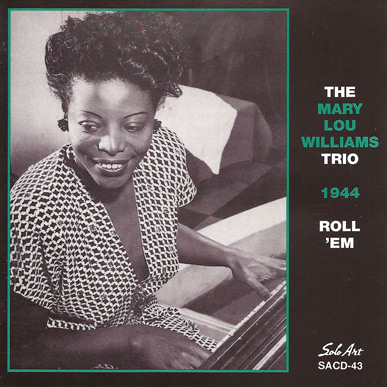
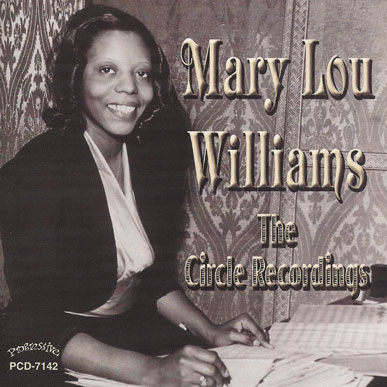
Frank Driggs, February, 1988 These hitherto unknown titles recorded in 1944 by Mary Lou Williams at the height of her popularity for World, are a delight to me. I was practically weaned on her piano recordings, particularly from this period, probably her most active in terms of recordings. None of those were made for major firms either. Those were her Cafe Society Downtown days and the final flowering of the kind of melodic and rhythmic jazz that was about-to be so abruptly displaced by something that would be called bebop and then modern jazz. Although Mary Lou Williams is from Atlanta and Pittsburgh, she really grew up musically speaking in Kansas City, Missouri in the late twenties and Depression years. If a jazz musician was unable to be in New York or Chicago in those years, Kansas City was very definitely the place to be. ... There were bright lights and a feverish after-hours atmosphere flourishing under the smooth hands of Boss Tom Pendergast who'd taken control of the "Heart of America" in the middle twenties and did not let go until municipal reform put him and his cronies behind bars and shut down the town briefly, in 1939. Mary Lou had come to town with her husband, saxophonist and bandleader John Williams from Memphis in 1928. They had had a band of their own and Mary Lou had toured in T.O.B.A. revues much the same way as Count Basie had and both had arrived in Kansas City and liked what they found. Mary Lou was a very able pianist almost from her Atlanta childhood. There she was drawn to the very full style of Jack Howard, a highly regarded local player who used boogie woogie figures. Her mother taught her the two ragtime pieces she would later carry forward in her career. She moved with her mother and sister to East Liberty, Pennsylvania, about six miles from downtown Pittsburgh when she was four and was soon known as the Little Piano Girl. Here she would find out about Earl Hines whose style would set the jazz world ablaze throughout the twenties. She heard and saw Lovie Austin doing what seerned impossible, playing the piano with her left hand, conducting the pit band with her head and writing music for the upcoming act with her right. Lovie became her idol and eventually Mary Lou learned to do these three things simultaneously. Her opportunity to spread her wings came when she became pianist for a touring revue called Seymour and Jeannette which included saxophonist John Williams who soon became her first husband. Williams' group made some recordings, most of which never got issued, for Paramount and Gennett between 1927 and 1929, the year Williams left the band when he joined T. Holder's Dark Clouds of Joy, which because of the leader's undisciplined behavior, soon became Andy Kirk's. Mary Lou kept the band working back in Memphis at a road house until one of the patrons, a Mississippi farmer, offered the gangster owner a large sum of money if he could take Mary back to his farm with him. By this time. John Williams asked her to join him in Kansas City, where the band renamed the Clouds of Joy, began making a name for itself with its emphasis on well-played ensembles and novelties. By chance. an audition to make records for Brunswick's lack Kapp came about in November, 1929. Kirk's regular pianist failed to show up in time, and a quick call went out to find Mary Lou who immediately secured the contract for Kirk with her full-blooded vigorous stomping jazz piano, the likes of which Kapp and few other record men had heard. Thereafter, the Kirk band had to bring her in to make the records and it was only a matter of time before she would move permanently into the band's piano chair. Learning how to arrange became particularly important after Kirk picked up a group of Hank Biagini arrangements, which Mary Lou studied, and with her husband's and Kirk's help. soon learned to be a highly proficient and original arranger. The Clouds of Joy earned a decent measure of success working out of Kansas City throughout the worst years of the Depression. although they suffered their share of being out of work. For Mary Lou those years remained precious, due to what she called "brotherly love" that kept the bands she worked in and knew close together musically and in spirit. A large group of the Kirk Decca's made from 1936 until she left the band in 1942 reflect her energy, spirit and imagination. The Kirk group stressed good section work, playing in tune and with a softer lead back approach to swing that kept them working steadily right until the end of the big band years after World War II. Mary Lou left the Kirk band, partially because her own popularity was being split with two of Kirk's newer stars. Then too, her marriage had broken down, and she had become enamored of one of Kirk's best trumpet players, Harold "Shorty Baker whose golden tone graced several of the best big bands including Redman, Wilson and finally Duke Ellington. John Hammond, who loved her work, introduced her to Barney Josephson who had opened the inter-racial nightclub Cafe Society in Greenwich Village late in 1938. Mary Lou had her own trio as well as a small combo including Baker, Vic Dickenson and for a time, Art Blakey on drums (this group did not record). She worked small clubs with her combo or trio and because of her interest in any new development in jazz, became enamored of and part of the bop movement of the late forties. Her Harlem home became a meeting and workplace for helonious Monk. Bud Powell Tadd Dameron and others. Her own trio worked at Bop City and other mid-town clubs until offers to tour Europe offering real money decame too tempting to resist. From December, 1932 through December, 1954 she enjoyed considerable success abroad making a number of new recordings, only to quit the business entirely to return to New York. The reasons have never been fully explained. but part of it was the rapidly deteriorating jazz scene back home and the destructive force of heroin that had ruined the lives of so many who had come into music after World War II. She resumed playing again in 1957, adapting some of the continual experimentation jazz has been subject to since her return. Mary Lou and Barney Josephson reunited again in the 1970s at his new Village restaurant, The Cookery, and at the end of her life she was artist-in-residence at Duke University. These transcriptions offer a well-recorded look at Mary Lou's accomplishments to 1944, and they are considerable in my opinion. There are just eleven selections accompanied by two tine rhythm players, bassist Al Lucas who later worked with Duke Ellington and drummer Jack 'The Bear' Parker who had been with Teddy Wilson among others. There are a total of 16 complete or nearly complete takes and it is maddening to hear her move out so imaginatively on her own Froggy Bottom (1929) only to interrupt it at 0:54 seconds. There are three takes of this. I favor Taurus from her Zodiac suite, the very timeless (I prefer this to "modern") incomplete take on Limehouse Blues Marcheta, showing Kansas City stride a la Basie which she excelled at, the classic Roll 'Em which she had never been allowed to record with the Kirk band because of her having sold her own brilliant arrangement to Benny Goodman who had a major hit with it. Roll 'Em shows how to play boogie woogie, a style with which she was often typecast in the mid-forties when it was a momentary national craze of a kind in music, and not boring the listener particularly if he or she were a musician. There are many moments in this piece where she does the unexpected, her ideas effortless and timeless. Listen to her beautiful achingly slow bluesy What's Your Story Morning Glory which Andy Kirk and most particularly Jimmie Lunceford, made such marvelous big band arrangements of. I like to remind myself that 1944 was a particularly fulfilling year for Mary Lou Williams. Recognition of her ability was nationwide and she earned quite a respectable living making marvelous music. Not an awful lot of her recordings are available now, so this is definitely one to have if you savor, as I do, finely wrought swinging and relaxed piano just so beautifully played. Mary Lou left us in 1981 but she is by no means forgotten and recordings like these remind us just what a fine artist she was.
PERSONNEL
TRACKS
OTHER RELEASES WITH MARY LOU
|
||