PRODUCT INFORMATION / REVIEWS:
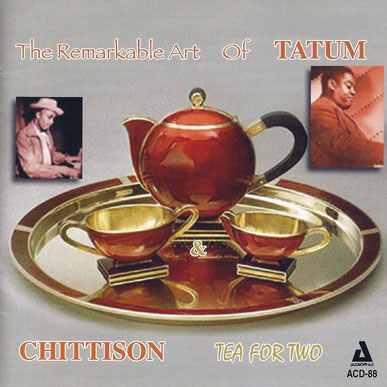
Herman Chittison was always in a hurry. I can see him now, just twenty years ago, walking from piano show room to warehouse, bent over Groucho Marx-like, at top speed, cigarette dangling from his lips he lit one with another all day long - seeking out the elusive "right" Instrument (his own seven foot grand was in the midwest at the time) with which to record what turned out to be his last testament. "We've got to move fast", he admonished me, after he'd drawn me Into his plans, to help him prepare a program of three albums and to find the right studio to record In. He went from Instrument to Instrument day after day, constantly shaking his head as he muttered to no one in particular, "green wood", rejecting all the top names in the business. He'd removed himself from New York, scene of all his major triumphs of the forties and fifties, and relocated to Akron and Columbus for the duration of his life which ended in Cleveland in 1967. I'd seen and heard many of the major names in jazz since coming to New York in 1955 Including Teddy Wilson, earl Hines (who I recorded later), Euble Blake, Mary Lou Williams, Claude Hopkins, Bud Powell, Hank Jones, Sir Charles Thompson, George Shearing, Billy Taylor, Marlon McPartland, Ram Ramirez, Sammy Price and too many more to list here. Of all of them, four stand out in my mind: Jay McShann, Thelonlious Monk, Herman Chittison and Marlowe Morris. They stand out because they seemed to me to project fire, purpose, determination and a perfection of their craft more than all the others. This Is not to say the rest did not make an Impression, they did, some a great deal more than others, but this group of four stand out for me. ... I heard Herman Chittison in not less than a dozen clubs from the Martha Washington Hotel in Greenwich Village to the in Boboll on the upper east Side and to the Old Absinthe House near 7th Avenue on West 48th Street. My wife and I dubbed him "The Fisherman" because he always seemed to be angling for a better deal. He was the only one I knew who refused to take a job unless he could use his own seven foot Mason and Hamlin piano. Sometimes he'd 11tay on a job, like Kenny's Steak Pub on Lexington Avenue, for weeks on end, and other times he'd be gone as soon as the engagement began. I remember a steamy summer evening eagerly anticipating a night of superb music after touting Herman's playing to some visitors from Europe, only to arrive at the Absinthe House to find one Norman Lester, squat and unimpressive, at the Chittison piano. Our disappointment was profound and we left before the first set was over. Herman Chittison was born in Flemingsburg, Kentucky in 1908 or 1909 and was largely self-taught and had given no real thought to being a professional musician until hearing fletcher Henderson's band while he was a student at Kentucky State College in 1927. Later that year he quit school, joined a local territory band and after gaining a certain amount of experience moved the following year into the midwest's best known band, Zach Whyte's Chocolate Beau Brummels. Here he met rising young stars like Sy Oliver. Al Sears and Vic Dickenson and made his first records with the Whyte band in 1929. Two years later after extensive touring with this group, he left and joined actor-comedian Stepin Fetchit who taught him a great deal about the accompanists role over the next year. He settled in New York and free-lanced throughout 1955, accompanying Adelaide Hall and Ethel Waters at different times, working with talented banjo and guitarist Ikey Robinson over WINS, and recording for Clarence Williams. In 1954, he joined saxophonist-singer Willie Lewis's band for a job at the Park Avenue Restaurant. Lewis had completed two successful years as a bandleader in Europe and was set to open the Chez Florence in Paris later that spring. Chittison needed no further encouragement and went to Europe with the Lewis band and stayed there for six years. Despite the fact that his main Inspiration came from earl Hines and fats Waller, he heard Art Tatum and was overwhelmed by that artist's supreme abilities, and began a period of excessive, intense practice, dally for hours at end, in an attempt to close the gap. His own technique was well above most others even then, and the practice and his determination to show himself in the best possible light brought him to prominence. Shortly after the Lewis band opened at Chez Florence, Herman Chittison was signed by Brunswick in Paris to make a series of solo recordings. They dazzled and amazed musicians and public alike with their blinding speed and prodigious technique. even though he was hardly a household name. Chittison left the Lewis band numerous times to make solo forays, to Join Louis Armstrong for a concert tour. and to spend a summer season at Juan les Pins with singer Arita Day (Dao) a Belgian girl who used body paint to appear Black and who was later tried for espionage in World War II. Chittison ertjoyed the living conditions and the comparative freedom and ease with which he seemed able to move about europe. By 1958 when he recorded for the Swing label he'd settled down and used his by now finely honed technique more in service of the music. He and other principal_ members of Willie Lewis's band left Lewis to form a cooperative group which spent all of 1959 playing Alexandria and Cairo, in Egypt. World War II put an end to this way of life and Chittison and the others all came back to New York and went their separate ways. He quickly became associated with Le Ruban Bleu, a smart new east Side night club, operated by Irving Jacoby, one of the principals in the famed Paris club le Boeuf sur le Tolt. He played for singers like Maxine Sullivan and formed a trio with guitarist Jimmy Shirley who had spent four years with Clarence Profit and different bassists Including Cedric Wallace who'd served fats Waller so well for an equal length of time. Mystery writer George Harmon Coxe became a fan at Le Ruban Bleu and together with several CBS radio writers and producers concocted the highly successful program Casey Crime Photographer and Herman Chittison was cast to play Ernie, the Blue Note pianist, and over the next seven or eight years his following Increased one hundred-fold. These were Chittison's salad days, he was among the highest paid in his profession - he took delight in telling me he earned more money than Art Tatum ever earned in his life during this period • and very comfortable playing for the wealthy and titled patrons of Le Ruban Bleu and Irving Jacoby's even more lavish club, the Blue Angel. If Herman Chittison never became the equal of Art Tatum or Teddy Wilson or earl Hines, nor possessed their Inimitable creative gifts, he was nonetheless a marvelous musician and a superb planlsl He always preferred to routine every song he did and rarely ever varied his approach once he was satisfied he was playing It to the best of his ability. He had long since taken himself out of any consideration for honors in the Jazz world. He knew those days were over and yet he never lost his skill for making finely crafted and rhythmic music. This Is what the listener will find here, a finished artist working at the top of his craft playing classics and standards with great elan at all tempos and with a fine beat and technique. He Is ably supported by guitarist Shirley and bassist Cedric Wallace. Together they make marvelous music. Frank Driggs, co-author, Black Beauty-White Heat.
PERSONNEL
TRACKS
OTHER RELEASES WITH HERMAN CHITTISON
|
||