PRODUCT INFORMATION / REVIEWS:
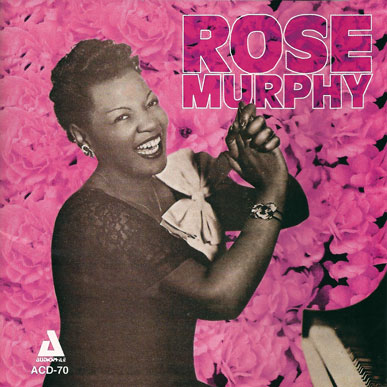
Rose Murphy initially gained public recognition at the end of the 1940s, particularly through her interpolation of "Chee-Chee" during her vocal on the standard tune I Can'tGive You Anything But Love, and her humorous vocals there and on many other hits provided great entertainment for a world just recovering from the dross of war. Yet,Rose's talents had been recognized long before that,especially by her fellow musicians, for she was also known as a dynamic blues pianist who could create great thunder with her rolling, stomping style. Actually, that vitality in her piano style, and her own rhythm section which she usually provided with the pounding of her right foot, was balanced against and complemented by her singing, and the "Chee Chee"expression has been best described by John Wilson in the New York Times as "bird twitterings." Yet, Rose Murphy's talents then and now go far beyond the imitation of birds, for as this record amply demonstrates she has great control of the keyboard and she also sings very much as she plays - subtly then strongly, happy then melancholy; and yet whatever Rose Murphy does is marked by her great spirit. Rose has a passion for her work that she displays every night, in every performance,and that spirit is infectious, and a night with Rose is more profitable to one's mood than a thousand afternoons on an analyst's couch. Rose will long be remembered for "Chee-Chee," but her long white gloves floating over the keyboard has been a trade mark in her personal appearances and several of her films as well. ... Actually, it seems that Rose's singing began to delight listeners almost as soon as she learned to talk, and a few years later she began to express that vitality through the piano. She was only seven years old, growing up in Xenia,Ohio, when her piano lessons began; and in a more subtle way there were always lessons on the radio from the great jazz bands of the swing era, singers like Ella Fitzgerald and Billie Holiday, and especially pianists like Art Tatum. As early as 1934 Tatum had an evening program, only fifteen minutes long but like a doctoral seminar for local pianists,that was broadcast over NBC out of Cleveland, and every pianist who heard Art Tatum had to be influenced by his virtuosity. The impact was obvious when Rose Murphy joined her high school jazz band, and even more pronounced when she went to Wilberforce College. Rose's family wanted her to seek the security of teaching,but she loved music too much to be switched from her vocation. Then, as if to support her decision, the gods smiled and even while she was in college Rose found a job playing piano at the Cedar Gardens in Cleveland, and she soon became a fixture there and at the other clubs in town.She was working regularly, but she still found time to listen to other pianists as they passed through town, especiallyTeddy Wilson and Mary Lou Williams. Rose insists, however,that she was not trying to imitate any other pianist,and there is strong evidence of that individuality on this record, especially because of the interaction between her fingers and right foot. As she says, "My foot feeds my fingers. I got a piano sound that's a mix of the piano sound and my foot." Usually, Rose did a solo act, singing as well as playing,but occasionally she was able to pry bassist Slam Stewart away from Art Tatum for club dates or recordings. She reminisced in the Times about the use of "Chee-Chee" in her act: "People asked me to sing a song and I didn't know the lyrics. So all of a sudden the chee-chee sound came tome. I was just kidding around. But people kept saying, 'do chee chee.' It's just part of me. It doesn't mean anything."It did provide that initial claim to fame, but Rose's talents are not one-dimensional, nor are they limited to any era or style. Rose reflects the vitality of what many identify as mainstream jazz, and just like 01' Man River she keeps rolling along with her audiences flowing after her. The point is that she has as large an audience today as she ever had in the 1940s, and proof of that comes from her major success at the Newport Jazz Festival in 1974 and again in.1981, when she generated the most heat of all the Kool performers. When not on the concert stage, Rose is regularly ensconced in the best clubs, where her trail of successes in New York City stretches all the way from CafeSociety thirty years ago to the bustling luxury of "TheCookery" recently. Now is the time to enjoy Rose Murphy,in person if at all possible, but a viable alternative is this record, an absolute delight. - JACK McKINNEY
PERSONNEL
TRACKS
OTHER RELEASES WITH ROSE MURPHY
|
||