PRODUCT INFORMATION / REVIEWS:
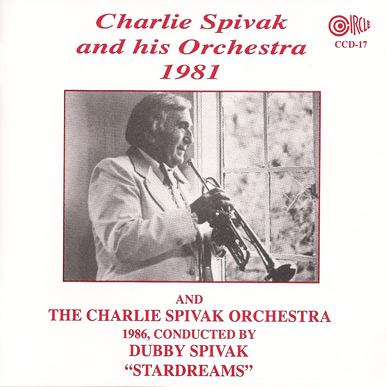
What a kick it is hearing cheery, chubby Charlie Spivak blow that potent horn of his once again - listening to that wonderfully clear,' ringing tone, just the way it used to sound when he was playing such a pulsating lead trumpet in some of the big band era's greatest outfits, including, of course, his own. Until now, for many of us Charlie had become one of the "Lost Greats" of those glorious times. We had heard that he had migrated to Florida and from there to South Carolina where he had settled down and was playing regularly in front of a small group in a nice, cozy roadside restaurant. But that's just about all we got to know about one of our favorite musicians. Down there, of course, he probably kept thinking about those good old days when he had helped spark the bands of Ben Pollack, the Dorsey Brothers, Ray Noble, Bob Crosby, Tommy Dorsey and Jack Teagarden. And then about his own band, the one he had formed in the early 1940s with the help of his good friend, Glenn Miller, and which had become so successful. He could recall fondly some of its superb musicians, like saxist Willie Smith, drummer Davey Tough, trumpeter Les Elgart, and a young trombonist, who also arranged, named Nelson Riddle. And some of its excellent vocalists, too, like June Hutton, who sang lead in a group called the Stardusters (and later with the Pied Pipers), and then Irene Daye, whom Charlie later married, and who sang with his group until she died in 1971. But obviously looking back was not good enough for Charlie - and certainly not for his many fans. And so, when in the late 1970s big bands began to return to the scene, Charlie started looking ahead instead. And what happened then? He organized another big band, stocked primarily with top musicians from the southeast, and which featured still another fine singer with a good feeling for jazz. And who was she? Her name at first was Dubby Hayes. But soon it also became Mrs. Charlie Spivak. Both Charlie and Dubby are rightfully featured throughout this album. And there are some excellent - sidemen too, notably a trumpeter named Tommy Richeson, who doubles on flugelhorn, and who impressed me tremendously one night early in 198 I when I caught the band during one of its too-few forays north of the Mason and Dixon line. It was a really good, clean, straight-ahead outfit that I heard that evening. But what knocked me out most of all was hearing Charlie, now well into his seventies, as cheery as ever and perhaps a wee bit less chubby, still blowing that thrilling horn of his, emitting a sound that, as you can readily hear here, continues to stamp him as one of the true giants of the big band scene. Welcome home, dear friend! -George T. Simon, Author of "The Big Bands" | "The Big Bands Songbook"
PERSONNEL
TRACKS
|
||