PRODUCT INFORMATION / REVIEWS:
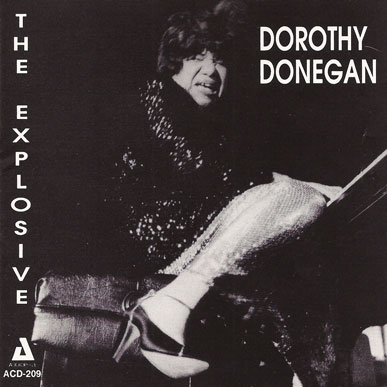
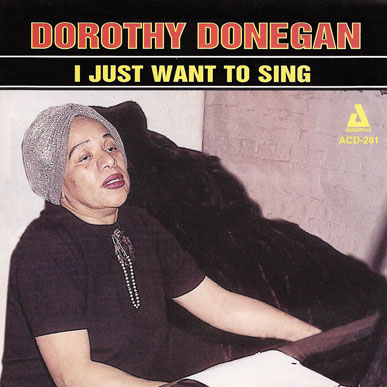
You're sprawled on a warm beach, your skin fairly glowing and growing tanner by the minute under the gentle heat of a summer sun. Got the picture? Now leap up from your towel and sprint into the icy waves. If that's the kind of shock your system enjoys, you're going to love Dorothy Donegan. When you're used to the styles of mellower, more restrained musicians, your first exposure to this dynamic woman can hit your ears like a pianistic plunge in cold water. The initial contact is rough, but soon you're feeling great all over. I got my first splash of Dorothy Donegan late in June of 1981 in Carnegie Recital Hall. George Wein, producer of the Kool Jazz Festival (It used to be the Newport Jazz Festival, but that's another story.) had signed her up for one of his afternoon piano solo slots and Donegan was already at work when I walked into the cozy, jewel-like auditorium next door to Carnegie Hall. Every head in the place seemed to be bobbing in time to the music as Donegan, her brow tightly furrowed and her left foot stomping a hole in the hardwood floor, made a major boogie woogie Gospel symphony out of "You'll Never Walk Alone." Making a quick segue to "Tea for Two," she rushed the old standard into double time, then triple time. Then faster and faster still. Her left hand dispensed thunder with the speed and regularity of a summer storm over the desert while her right ignited dazzling bolts of lightning. Her playing was a bracing, almost shocking combination of technical virtuosity and soaring, free-wheeling imagination. She played like no one else I'd ever heard, with an enthusiasm and joie de vivre -- and humor -- all too rare in jazz or any other form of music. A couple of nights later Donegan played in Carnegie Hall itself on a program featuring several women musicians and by the time it was over she was the talk of the festival. Those appearances marked her return to American audiences after several years spent playing in European night clubs and hotels. On this side of the Atlantic, muc'h of her concertizing has involved guest appearances with symphony orchestras, doing what she describes as "the classical bit," followed by a jazz turn. She digs Chopin, Liszt and Grieg, and recently said of one of her performances, "it could have been a little bit better. It wasn't Vladimir Horowitz, but it was pretty good." ... Donegan began working with the classics as a child in Chicago, but by the time she was a teenager she was playing jazz professionally. She went to Hollywood to film "Sensations of 1945" and in that same year she hit Broadway in a production called "Star Time." In the 1950's she established a considerable following at Ralph Watkins' Embers in New York and several other clubs, then she married and for the nonce retired from the scene. Eventually she got unmarried, as people will, and returned to her career. Nevertheless she has remained a stranger to most American listeners, owing both to her travels abroad and to her scarcity on record. She did cut a few albums during the 1950's and 1960's, but it has been several years since her last American release. This recording (If there's a better single word than "explosive" to describe her, I can't think of it.) should help to rectify that sad situation. With Ray Mosca on drums and Jerome Hunter on bass helping to keep time, Donegan establishes her inimitable style from the opening track, "Lover," playing it at breakneck speed but finding time for a scattering of melodic fillips. She builds a crescendo, falls away, then constructs another one grander than the first. At last she hurtles to a final crescendo more massive and exuberant than all the rest and eventually lets the main theme flutter to the floor like volcanic ash after an eruption. "The Lady Is A Tramp" continues in the same pyrotechnical way, but in "I Like the Looks of You" Donegan shows off her gentler side. Her playing is almost dainty, suitable for a beginning dance class. "I Just Want to Sing," one of two Donegan originals on this disc, projects an attractive, engaging melody and a casual, loping sort of pace. Donegan lightly understates "Love for Sale" and brings out the delicate shadings in Cole Porter's original work. She opens Side Two like a figure skater, gliding carefully and deliberately over "The Man I Love." Abruptly she switches gears and identities and she's a hockey player, fiercely, almost brutally, dashing and smashing through all opposition in a furious rush to the goal. "Donegan's Blues," which owes as much to the bruisingly vibrant world of rock 'n' roll as it does to the blues, swings with the power of the pendulum of Big Ben, if Big Ben has a pendulum. Following the beguiling change-of-pace Latin rhythm of "Wave," Donegan tackles the classic "St. Louis Blues." She plays myriad subtle variations on W.C. Handy's perennial theme but never loses track of it. The recording is notable for its craftsmanlike precision as well as its youthful quickness. So here is Dorothy Donegan, as experienced a newcomer as you're likely to find anywhere, a pianist of insight, skill, energy and exhilarating spirit. Such a combination is rare indeed. Robert P. Laurence, 1981: The San Diego Union
PERSONNEL
TRACKS
OTHER RELEASES WITH DOROTHY DONEGAN
|
||