PRODUCT INFORMATION / REVIEWS:
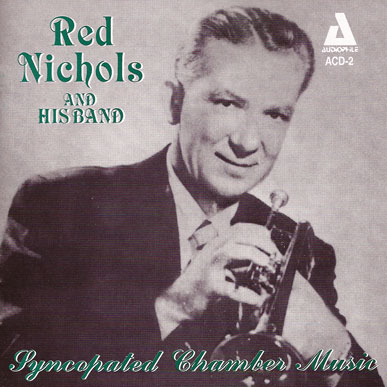
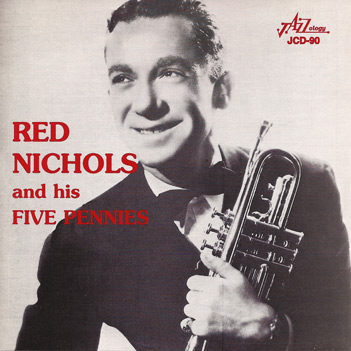
This Red Nichols material was originally issued on Audiophile AP-7 and AP-8 which were 78rpm microgroove records. Because of their exceptionally fine audio quality they were widely used on high quality playback equipment for demonstration purposes. The material was subsequently reissued on Audiophile 12' LP number XL-326 in more conventional form. The musical material on this album AP-2 has been taken from the original tapes used for the 1953 recording, rearranged in sequence slightly, but not altered in sound in any way. - George H. Buck, Jr. These particular recordings were the first he'd made in three years and would prove to be the only ones he made over a five year period. They were made by the eccentric and nearly deaf engineer Ewing Nunn for his Audiophile label. Nunn's deafness did not prevent him from making state-of-the-art high fidelity recordings and with Red Nichols Syncopated Chamber Music, he got some of the very best jazz he could have hoped to record. Frank Driggs, co-author, Black Beauty - White Heat ... Only two of the soloists are known to record collectors. Veteran clarinetist Matty Matlock may well be the star of the album because he is featured at his best throughout. The other is bass saxist Joe Rushton, one time California Rambler, Ted Weems and Benny Goodman sideman known for his affinity for motorcycles. One might conclude that Red Nichols would be the star of his own record, his first in three years. This is not the case, unless you look behind the soloists and note the content of the album, the tunes, how they are presented, the form and shape they have. This is Red Nichols' message, far more than his cornet solos. Red Nichols was a good player, make no mistake about that, but even he knew it would always be wise to feature his sidemen, since he hired them with care. The two trombone players are very underrecorded and perhaps under-appreciated talents. Not by the musicians with whom they worked professionally but by the public at large. Kingsley 'King' Jackson was from Muskogee, Oklahoma and barnstormed all over the Southwest from 1924 with Niles Esrey, Jack Kane's Goldjackets, Marshall Van Pool and Jimmy Joy before settling down in Los Angeles during the Depression. He recorded with the fine Seger Ellis Choirs of Brass big band and did a lot of studio work before he passed away. Ted Vesely came from lowa where he made an impression touring with Frenchy Graffolier's outstanding territory band in the midwest before he joined Benny Goodman in 1940. He later led his own jazz units in Los Angeles and passed away some years ago. Oklahoma pianist Stan Wrightsman worked alongside King Jackson in the Marshall Van Pool band in Oklahoma City and settled in Los Angeles in the Depression. He was an outstanding pianist in any kind of role he chose to perform and he is in fine form on this recording. Wolly Culver worked in big bands and small groups with Red Nichols and Nick Fatool's drumming has been in demand for fifty years. He is particularly tasteful on Easter Parade. The highlights of this recording include Willard Robison's Peaceful Valley, Corky, I'm On The Gravy Train, Manhattan Rag, and I Can't Believe That You're In Love With Me. Listen to the Dukeish touches on Three Blind Mice and Tin Roof Blues. This kind of playing and interpretation seemed to be Red Nichols' alone. I think it bears repeated listening. Many young players coming into the world of traditional jazz would be wise to spend some time listening to this record and to hear how much sense it makes, not to mention how much good music. There are very few records out by Red Nichols. This is a very good place to get to know his work. Red Nichols was a man seemingly out of step with most of his fellow jazzmen. Grudgingly acknowledged by most of them for his musicianship, he nonetheless seemed to stand apart. Jazzmen of his generation came to maturity in the roaring twenties, and because of the quicksilver nature of their art, often played the fool by getting drunk, disappearing and otherwise being irresponsible. These qualities were often overlooked because of their improvisational abilities. Some of the best jazzmen of that time and later were poor readers. Red Nichols sidestepped these pitfalls. Red Nichols did his share of drinking and carousing as a very young man on the way to the top in the early and middle twenties. But because he'd been drilled relentlessly by his bandmaster father - he had to practice his cornet an hour each morning before he was allowed to eat breakfast he became a boy wonder and a professional musician very early. A series of jobs after dismissal from Culver. Military Academy for smoking, found him in the midwest where he was able to go to Atlantic City. The endless practice produced in the nineteen year old musician, a polished professional who was able to move into the burgeoning world of recording and hotel and night club jobs in New York. Red Nichols very quickly became a star playing and recording with Sam Lanin, Johnny Johnson, Bennie Krueger, the California Ramblers, Don Voorhees, Ross Gorman and Paul Whiteman. Nichols' fine tone and seemingly inexhaustible supply of ideas made him the darling of recording supervisors for a dozen labels and he became with his Five Pennies, Redheads and other pseudonyms the major name in the twenties. Hundreds of records ensued, few of them reissued and fewer in print today, a shameful neglect of a major body of work by a man who always played challenging music. Red Nichols got to make all these records because he read superbly, made friends with the contractors, and above all, made time and was sober most of the time. And Red Nichols liked form to his music, he didn't want to just jam chorus after chorus as most jazz musicians preferred to do then as well as now. He wanted shape and structure in that jazz format and he produced outstanding music in quantity. The depression finished off his kind of music, and nearly killed off his career as well. He led big bands throughout the decade, most often well away from New York where he had been a major star only a few years before. He came back to New York in 1935-6 as a conductor for Ruth Etting and Bob Hope on two sponsored radio programs. He did little or no playing, just conducted using his real name Loring Nichols. He hit the road again in 1937 and stayed on the road leading big bands until 1942 when his only daughter contracted polio. He sold his band to Anson Weeks and took a welder's job in the shipyards in California until her health came back. By mid-1944, he was ready to get back into action. He was hired as a featured soloist with Glen Gray's Casa Loma Orchestra, with the promise of building a small ensemble around him; Red Nichols was back. It was not a fruitful association however, and after six months, Red left to form a new version of his Five Pennies playing the kind of music he had always loved. Los Angeles was still enjoying the war-time industrial boom and Red Nichols moved easily from club to club, contract to contract, without having to endure the rigors of one-night stands that made the big band days a nightmare to so many. He began recording again for Capitol and Mercury, two new companies that thrived in the post-world war economy. Red Nichols still loved to have a specific form and shape to his music, and not to play in the 'dixieland' style which seemed to catch on with record executives for a time in the 40's and 50's. He wanted rhythmic music, melodic music, played hot, but with dynamics and shape and written arrangements. Eventually the companies lost interest in recording him. By 1950, there were no more records. This did not affect him much. Clubowners who welcomed his brand of music kept him working steadily.
PERSONNEL
TRACKS
OTHER RELEASES WITH RED NICHOLS
|
||