PRODUCT INFORMATION / REVIEWS:
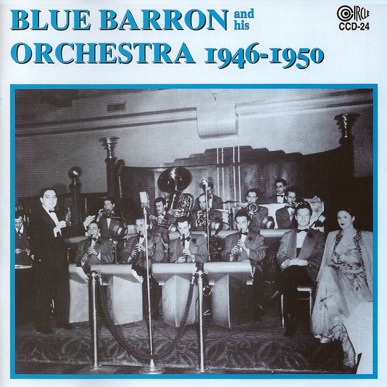
In appearance, Blue Barron was a short, stocky man; a man possessed of a great sense of fun and a bubbling personality (which hid a shrewd business mind). From the mid-thirties, until the sixties, he led a sweet band which enjoyed particular success in the mid-west, where this type of big band music was especially popular. Born Harry Friedland, in Cleveland, Ohio, he attended Ohio State University, where he played violin in a campus band. Following gracfuation, Barron became a booker of dance bands in Cleveland and the surrounding area. At this time, he met Sammy Kaye, who became his partner and for whom he served as manager for some years. It is a popular misconception that Blue Barron played in Sammy Kaye's band. In 1936, Blue went on to form his own orchestra, capitalizing on the contacts he had already established through his successful band booking agency. He had no difficulty gathering his personnel or settling on the style of music he would adopt. His former college roommate, Red Atkins, directed the band and stayed with Barron for his first two engagements - 2 weeks in Troy, New York, followed by a long-term hotel booking in Rochester. Because of his previous close ties with Sammy Kaye, it was only natural that Kaye served as a model for the music Barron played. Other leaders who influenced his musical style included Kay Kyser, Jan Garber, Horace Heidt and the man who, until recently, was so closely associated in everyone's mind with New Year's Eve, Guy Lombardo. ... One "gimmick" Blue Barron adopted from Kyser was the singing song title. When introducing a medley, Barron inserted a few bars of each song to be played. It was a catchy trick which his fans came to recognize and expect. Likewise, Blue would deliver a brief wordage over his theme, Sometimes I'm Happy. Barron's style was further distinguished by his use of glissing trombones, a mellow saxophone section and an electric steel guitar, a quite unusual instrument to be featured in a dance band. It is interesting to note that while many of the big bands of the day were - so far as the musicians were concerned - "revolving doors" Barron had relatively few changes of personnel; those who came into the orchestra stayed with the orchestra. it was quite a tribute to the leader as well as an asset to the band. In the second half of the thirties, Blue Barron's musical organization was busy turning out record after record ... all of which contributed still further to the public's awareness of a man named Barron ... and his merry men of music. With these discs, plus 3 weekly broadcasts on NBC, the band landed a contract at the Green Room of New York's Edison Hotel. The "Barron Boys" opened there in January of 1938 and occupied that distinguished dance spot for many months. With many broadcasts each week, plus a recording contract with RCA's Bluebird label, the band was truly riding high. The Blue Barron orchestra achieved a total of 94 sides for Bluebird - a most impressive track record for any orchestra. Unfortunately, the quality of the later tunes deteriorated steadily and, rather than record mediocre material, Blue left RCA in December of 1940. Shortly thereafter, he signed on with Elite Records. He broadcast regularly for the NBC, CBS and Mutual networks - exposure which ultimately landed the orchestra onstage at the famous New York Paramount Theatre on Times Square. Blue was "big" on vocalists ... his first being a young kid of only 16 - Russ Carlyle! Others followed: Clyde Burke, Jimmy Brown and Charlie Fischer (the latter two were sidemen with the band). The trio, which came later, was called the Three Blue Notes and consisted of Fischer, Ronnie Snyder and Russ Carlyle. Like many other band leaders, Blue Barron's career was interrupted by World War II. During his stint in the Airborne Infantry, the band continued under the leadership of still another singer - Tommy Ryan. After his discharge from service, Blue Barron switched re~ording affiliations from Elite Records to MGM Records. Although he recorded his biggest hit for MGM, the million-record seller, Cruising Down the River, Blue found that the fickly public had changed its musical tastes during the war years. The end of the early forties ushered in the era of "cool jazz" and a movement away from sweet band music - Blue Barron's stock in trade. There are many stories told about the ebullient Mr. Barron, but my favorite revolves around an engagement he played at the Adams Theatre in Newark, New Jersey - my stomping grounds. It just so happened that Blue's week at the Adams coincided with the Jewish holiday of Channukah. You will recall that his real name was Harry Friedland ... and he was very mindful of his Jewish heritage. During one of my conversations with Barron at the theatre, he bemoaned the fact that he couldn't celebrate this Holy time with his family at home. That was all I had to hear. I, too, am Jewish, and - even more important - my beloved father (since deceased) was a very orthodox Jew. When I told him of Blue's unhappiness, he quickly responded with, "Well, what are you waiting for? Invite the man to our Channukah services at home!" So that year Blue Barron, between onstage appearances at the theatre, did celebrate "at home with family." My home and my family. I shall never forget how pleased he was that night. And I don't think he'll forget it, either. Paul Brenner
PERSONNEL
TRACKS
OTHER RELEASES WITH BLUE BARRON
|
||