PRODUCT INFORMATION / REVIEWS:
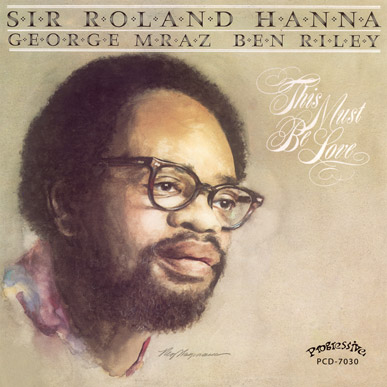
 It was Roland Hanna who suggested that this recording be titled "This Must Be Love." His reasoning was quite simple. "You keep playing music, traveling, doing one album, then another. This must be a labor of love," he said. So Hanna's labor of love has produced yet another album, a collection mostly of love songs from Rodgers and Hart. Even during his early days of growing up in Detroit, there was always music in Hanna's life. Initially it was the gospel sounds that he heard regularly at his father's (a preacher) church. By age 8, he was teaching himself to play Bach, Chopin, and Beethoven, as well as co Hanna remembers the discovery vividly. "During high school I would spend most of my day practicing classical music in the auditorium, because it had a big nine-foot Steinway. At times there was another pianist there and we would exchange ideas. His name was Tommy Flanagan, and it was as a result of listening to him play that I became interested in jazz." ... "What Tommy was doing came easily to me," Hanna remembers. But finding work as a jazz player was another story. "If you said you played jazz, then you didn't work. Jazz was a dirty word," Hanna says, adding that "It's still that way today." So despite his natural affinity for jazz, Hanna set his sights on mastering European classical music, an art form that he admits "was very unnatural for me, because the music in many ways goes against the natural and innate rhythmic sense from my black African heritage. I had to really relearn music to play European classical music." The "relearning" process took Hanna in the early fifties to Rochester's Eastman School of Music, and then later to Juilliard where he spent 1955 through 1960. Listening to Hanna today, the classical training, and particularly its effect on Hanna's original material, remains one of the most distinctive and charming aspects of his style. Throughout the 1950s, Hanna continued to play jazz, but it was an offer from Benny Goodman to play with him at the 1958 Brussels World's Fair that served as a springboard for his jazz career. Following the stint with Goodman there was a year (1960) with Charles Mingus, several with Sarah Vaughan, and then a long and fruitful association with the Thad Jones-Mel Lewis Jazz Orchestra, which had its origins in a suggestion by Hanna to Jones that he form a big band. Despite his rich musical pedigree, Hanna, like so many other jazz musicians, has not had an easy time pursuing his "labor of love." Out of necessity Hanna spends seven to nine months each year touring Europe and Japan. He freely and somewhat bitterly acknowledges, "If I had to depend on making a living in America, I guess I couldn't do it playing music alone." That the respect for Hanna's talents (and jazz in general) is not as great in America as it is in other parts of the world, is further underscored by Hanna's recording career. He's recorded more than 30 albums, but many (and unfortunately some of the finest) have been released by foreign companies with little or no distribution in the United States. Which brings me to This Must Be Love, a session produced by Gus Statiras in New York, but first released in Japan. Until now it's been one of those Hanna gems that was generally unavailable to his American fans. Hanna's supporting cast, bassist George Mraz and drummer Ben Riley, need little introduction to seasoned jazz fans, especially those familiar with Hanna's career. Both have accompanied him many times and have been part of the adventurous, but too seldom heard from, New York Jazz Quartet, co-led by Hanna and Frank Wess. Mraz, whom Hanna met while both were members of the Jones/Lewis Orchestra, is virtually a fixture on Hanna recordings. He doesn't get the press of Ron Carter, but having heard him accompany singers, perform in a big band setting, and work his small ensemble magic, I am among those convinced he is one of the modern masters of his instrument. His thick, constantly inventive bass figures, and the way he weaves them through Hanna's piano lines, never fail to add dimension to their joint recordings and performances. This Must Be Love was originally planned as a Rodgers and Hart collection, but Hanna approached the producer, Gus Statiras, about including a few of his own tunes. Reflecting a certain pragmatism, Hanna reasoned that Richard Rodgers was wealthy enough and asked Statiras "why not let me play some of my own music, so in case the album sells, I can make some of the money." Fortunately Statiras agreed, and Richard Rodgers' loss has become our (and hopefully Hanna's) gain. Perhaps Hanna sums up This Must Be Love best. Upon hearing that these performances were now being released in America, he thought back to the recording sessions. "I remember how we felt after we recorded," he said. "We listened to the tapes for a long time and were very pleased. Then I recall we came back to them several weeks later and listened again and they still sounded good. It's a good album and people should hear it!!!" Having listened to these performances many times over the past few weeks, this Roland Hanna fan wholeheartedly concurs. This Must Be Love is first class in every respect. Audiophile deserves special thanks for making it available. Jack Frieden The Virginian-Pilot and Ledger Star, Norfolk, Virginia
PERSONNEL
TRACKS
|
||